Saturday, May 30, 2020

250 Birds in 5 Months

Not a great photo
Laughing Gull,
Bird #250 in 2020
   As I've said ten thousand times since the end of last year, I didn't have any birding goals for 2020. I did my "RI Big Year" last year and didn't plan on repeating it. I had plenty of other things I wanted to do this year. I had multiple getaways planned and knew I would miss some birds because of them. But, as we all know, the world turned upside down this spring. I didn't get to go to Race Point to see migrating Right Whales in the beginning of April. At the end of April I planned on backpacking to wilderness waterfalls in NH swollen by snowmelt. Lastly, I had a trip to Plum Island for a weekend in May that of course didn't happen. Not to mention many more to come. My only real hope was to hit 250 species for the year. If I didn't reach that goal, it didn't matter since I had so much other fun planned

   So I did what I always do on my days off, I birded. That said, Mother Nature was not kind to me this winter and spring. If we had two days a week of bad weather, they fell on my days off. None the less, I persisted. There really isn't much else to do in the winter, so I chased birds. I had a fantastic January. I ended up seeing 125 birds by the end of the month.

Last year I chased every single bird I could. If a good bird was reported while I was at work, I'd go as soon as I got out. That was great, but I didn't need the stress of that pressure this year. Not to mention I went through  a set of tires in a year and put tens of thousands of miles on my car.  I realized, that if I just birded on my days off during the first four months and birded like a banshee during May I should see most of the birds. I figured by not chasing birds after work and only on weekends I'd still see 90%of the species seen.  I stayed true to this experiment. From January to April I only chased 3 species after work, a White Pelican, Blue Winged Teal, and Wilson's Plover

As of April 30 I had 171 species. May is the big month for migration so that number was going to sky rocket just like all of the other birders. May is a whirlwind for birders. It is filled with color, excitement, and exhaustion (you can sleep in June). On May 24 I had seen 246 species. I realized I could get 250 if I got lucky before the end of the month. I got my 250th bird last year on June 1, and it sort of aggravated me that I couldn't have gotten it in May. Two hundred and fifty species in the first 5 months (50/birds/month) has a nice ring to it.  

Looking at my list, there were two easy birds I could get. They were Seaside and Saltmarsh Sparrows. I set up a kayak trip with a couple of friends for Wednesday night at the Charlestown Breachway. We had fun and saw a bunch of birds. Happily, we saw the two species of sparrows. This meant I only had two to go and gave me a fighting chance.

   Well, Mother Nature or the Weather Gods did not make life easy. There weren't any more easy birds left to chase. But I knew where two hard birds were. There was a Least Bittern at Trustom. It had been seen or heard the last few days. I woke up Friday morning to some heavy rain. None the less, I went to Trustom. For two hours I stood soaked from sporadic rain showers until the Bittern finally decided I suffered enough and made a grunt call as I was about to leave...one to go. I tried the rest of the day to find another new bird. I went to Great Swamp with my friend Sue among other places. 

   The other bird I knew about was a Mississippi Kite. This is a really rare bird in New England. For some reason, one pair decided to nest in Rhode Island last year. They were the first known MS Kites to nest in the state. They are back again this year. Unfortunately, the nest is on private property and can not be seen from the road. Still, when they soar or fly, you can see them. Most of my friends had seen them already. I tried multiple times to see these Kites. In the last week I tried three times for a total of six hours hoping for a glimpse of them. Nada.

All was not lost, Sports fans. A Laughing Gull had been seen at Brenton Point State Park Thursday and Friday. I was looking for the Kite on Friday when I found out it was still there. I couldn't bring myself to drive from Richmond to Newport at 5 pm. So, when I woke up at 5:30 am today, that is where I went. When I got to Newport the fog was so thick I could see maybe fifty feet. I walked up an down Ocean Drive, but the gull wasn't on the rocks. If it was out to sea, there was no way I could see through the fog. After two hours I gave up. 

I headed to Napatree where some of my friends were birding. I decided my best bet for one more bird was to make the long walk out. You never know whats out there. Sue and I were fifteen minutes behind some other good friends.  When we got out to the lagoon we saw our first of the year Laughing Gull. Bird #250 (and 259 for Sue).
Wilson's Pharalope

After Napatree we walked the mudflats of the Charlestown Breachway. I found a Wilson's Pharalope that was very cooperative and walked almost right up to us. After we left the Breachway, Jess Bishop talked me into stalking the Mississippi Kite again. I had no desire to spend any more time in the neighborhood. Plus I has hungry and tired. Instead of arguing, I took the path of least resistance and went along. About 30 minutes into our stakeout the Kite made three passes over us. One of them, it was quite low and we had a great look at its tail pattern and could see all of its colors. It was incredible. Bird #251


Usually I end a post like this with "what's next". Truthfully, I don't care. I'm not going to guess how many species I might end up with. I'm not going to look over the list of species that haven't been seen and try to figure out how many I could see. Now that May is over, I'm not going birding after work unless it is a close walk in the woods for exercise. I'm not going to South County to chase birds after work.  

As for my experiment to see if I could still see 90% of the birds only going two days a week, and going hard in May here are the stats (these are based off of Paul L's site and not ebird).

The leader to this point is Sue Palmer she has seen 259 to my 251. So I have seen 97% of the birds the leader has.

There have been 264 species seen so far in 2020. I have seen 95% of them. 

All that said, even though I am only 8 species behind the leader. I have absolutely zero chance of catching up.   The birds that she has that I don't are what are known as"blocker birds". These are birds that are very rare and won't show up again this year. They could potentially block me from taking the lead. So I really have no chance of finishing in the top 3, nor do I care. I'm not shooting for forth, or fifth, or whatever. I just want to  have fun, which is what I'm doing. Today was awesome!


  Lastly, as always, I am truly awestruck that I have fallen into a group of fantastic birders way better than me, that are so unselfish caring people. It blows me away they consider me a friend. One of them is celebrating a birthday today. Happy Birthday Jan.
Photo stolen without permission, but I'm in it
so oh well. Me, Jan, and Sue
smiling under our masks. 

Monday, May 18, 2020

Rose Breasted Grossbeak Upgrades and Warbling Vireo Life Photo

   I went to Cumberland Monastery today to find Mourning Warbler. I didn't find it, but I did get a life photo and a photo upgrade. The life photo is of a  Warbling Vireo. They are a fairly common bird but always seem to be up in the top of the canopy.

Below are pictures of Rose Breasted Grosbeak. This is another common bird. However, it has been sort of a white whale for me. When I try to get a photo its in bad light or behind a leaf. The best photo I had before today was of one right in the open, but it was molting and looked like hell. Despite the bad sky, this one stayed low enough for upgrades. 

Life Photo of Warbling Vireo

Two photos of male Rose Breasted Grosbeak


My previous best photo of this species

Saturday, May 16, 2020

Fallout!

 
    As many of you know, May is my favorite month. My friend Dave and I say, everything is good. Whether you fish for bass, trout, stripers, or carp, May is probably the best month. Also, May is the month for spring migration for songbirds. All the birds that "go south for the winter" come up here in the spring. Most go north of us to raise a family. Catching them on their spring journey is something all birders look forward to the rest of the year.

   Unfortunately, we have been waiting longer than normal because the weather has been awful. Most of the month has produced north winds. Winds from the north would be a headwind the birds would be flying into. So the birds wait for the wind to change. These birds still have to get to their nesting grounds because summer is short up north. So when the wind turns south, the birds have to go.

    Well, yesterday the wind was from the south. When we went to bed it was perfect for birds to fly north with a tailwind at their back. Then, it started to rain grounding the backlog of birds that had been waiting for days to head north.

I started the morning at Swan Point Cemetery. There were a ton of birds for about half an hour. I got three of my targets I thought I'd miss ( Blackburnian, Bay-Breasted, and Eastern Wood Peewee). After that half hour, I puttered around another 90 minutes with varying degrees of luck. I knew Miantonomi Park in Newport was hopping with a lot of birds because many of my friends went there. But, I figured like Swan Point it would die down and it wouldn't be worth my time to go there. Finally, at 9:15, I texted my friend Jan and asked if Mia was still birdy. Her response "OMG yes!"

So I drove down hoping to see some of the birds they had seen. Jan and others heard then saw a Tennessee Warbler which is a yearly visitor, but usually only one will show up, so if you want it, you better go after it. Tennessee would be a lifer for me, so if nothing else, I was hoping to see it or at least hear it.

I got to Mia at 10 am and the number of birds was almost indescribable. There were warblers dripping from almost every tree. Some trees would have five different species of "good birds". For example, one tree I was looking at had 2 Indigo Buntings, 2 Blackburnian Warblers, a Cape May, and a Scarlet Tanager.
Dead center of this very heavily cropped photo is the
Tennessee Warbler (lifebird)

There were multiple rare species. I ended up seeing, hearing, and getting a bad photo of the Tennessee. There was a Prothornotary Warbler, a couple Wilson's Warblers, Cape Mays, a Canada Warbler, and Summer Tanagers. I didn't see all of these species but they were all there. The most amazing thing was the number of Bay-Breasted Warblers. Bay-Breasted aren't as rare as Tennessee, but they are rare. They were dripping from the trees. I can't tell you how many individual Bay-Breasted I saw maybe 30-50. No matter the number, it had to be  quadruple what I had seen previously in my life combined.

There were hundreds of the more common species also. Yellow Warblers, Common Yellowthroats, Redstarts, and Yellow Rumped Warblers were there too. All told, there were twenty two species of warblers at Mia today!

 I didn't see all twenty two. I spent most of my time taking photos of the birds. The only species that I missed that I put in time looking for was Canada Warbler, but most people didn't see it. My friend Carlos, who is literally a world class birder and been doing this for years said this was the most birds he had seen in one place in Rhode Island. I am glad I got to experience it.

Tons of photos below. Hard to pick out just a couple

Three photos of Yellow Billed Cuckoo


 Female Cape May below
 Two photos of Indigo Bunting

                                                 Three Photos of Bay-Breasted Warbler


                                                        Blackburnian Warblers below


   All things being equal, Black-Throated Blue(below) is my favorite warbler
 Female Rose-Breasted Grosbeak

Friday, May 1, 2020

May Day/ Great Day

Honestly, I don't know how I have seen more than gulls and Robins this year when I go birding. Almost every week it rains or snows on at least one of my days off. Sometimes both days. If we get four days of clear weather you can be sure that fifth day when it rains will fall on my Friday off from work.

   But today is May 1. So despite the shitty weather this morning, if there was any clearing, I was going outside. Luckily, the rain ended about 9:30 am so I headed out and had a spectacular day.

   I started my day social distancing as far as I possibly could from people. I went to the mudflats at the Charlestown Breachway (you need a kayak or a willingness to walk 3 miles and cross a waist deep channel). Within an hour I got three new birds. I saw a Willet (very common), White Rumped Sandpiper (somewhat challenging bird to find), and adult Yellow Crowned Night Heron (usually pretty hard to get but their numbers seem to be increasing). I was happy. There was a lot of fog before it cleared up and I ended up missing a couple of easy birds that I am sure I will get. My friend Carlos went out as I was coming in. He found another good bird a Bonaparte Gull in an area I didn't go. This is a bird I have a tough time seeing so it bothered me a little that I missed it.
White Rumped Sandpiper

   Later on I followed my friend Jan to Mill Pond where I got to see and hear a Northern Parula. She went home for lunch and I went to Trustom. There I saw a Yellow Warbler and a House Wren. I had heard both species last week but didn't see them. These are both common birds, but nice to have back.
 
    The main bird I hoped to see at Trustom was a Cliff Swallow. I didn't see it, but while I was looking for it, I saw many Purple Martins mixed in with Tree and Barn Swallows.  Most surprisingly, I saw a Raven fly over. It would have been impossible to miss the spade shaped tail

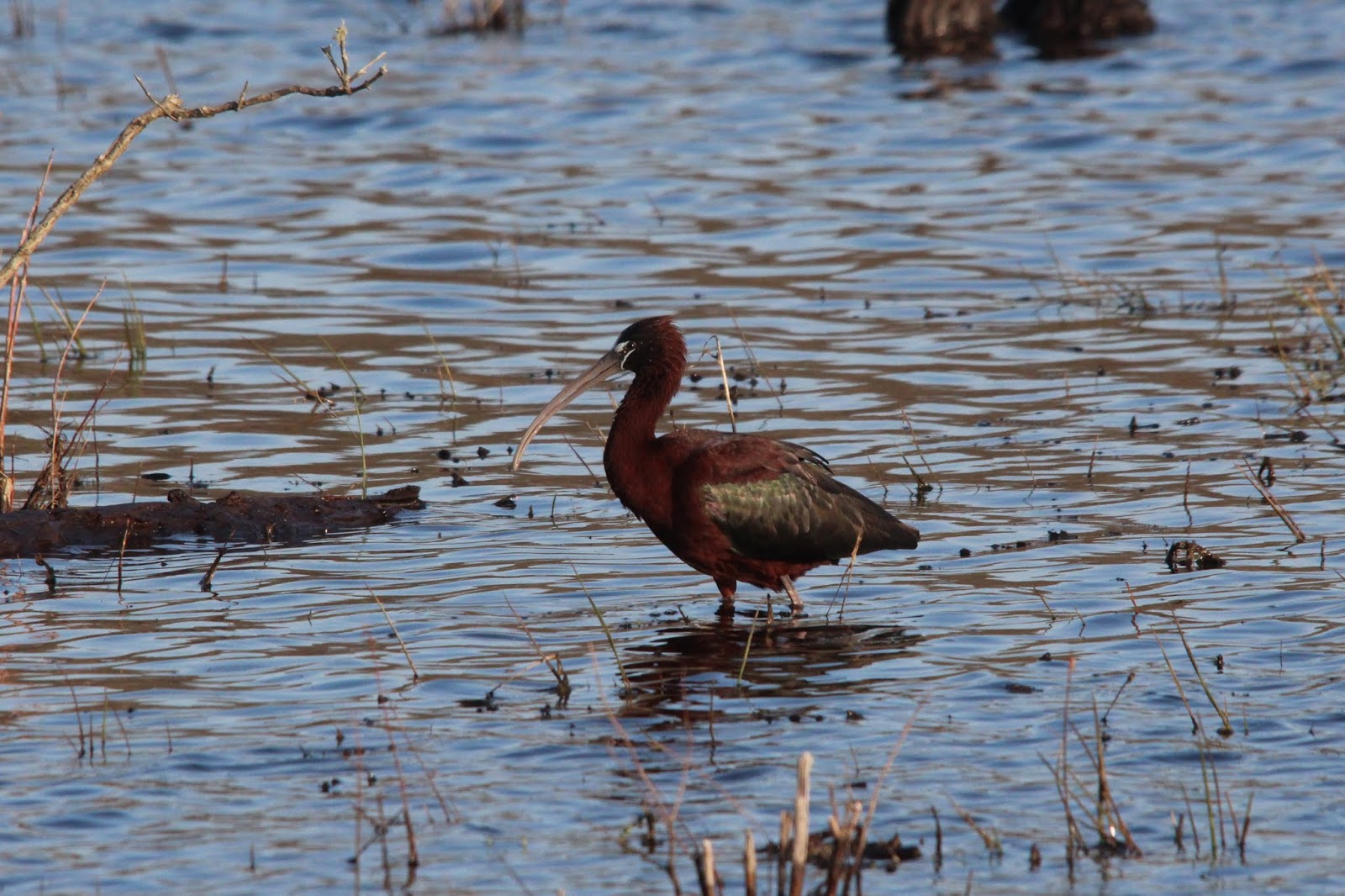
   The last place I went was Great Swamp. While I was there I found an Eastern Kingbird. I also saw Glossy Ibis which never gets old. Back at the parking lot I had two other birds. A Broadwinged Hawk flew right over me. It was just gliding slowly in the light breeze. I got a great extended look at its underbelly and underwings. It was probably my favorite part of my day.
 

 As if that wasn't enough in the parking lot, there was also a Black and White Warbler. They are one of the most common warblers. However it was a first of the year bird for me, and they are really cool looking.

I've complained multiple times on this blog how it seems I'm just chasing reports when I go birding. It is even worse when you only have one day a week of nice weather. You don't have enough time to just explore. Chasing reports is almost like a business trip. Today was different, I took my time I went where I wanted and had my own plan. The only bird I "chased" was the Cliff Swallow but I spent a lot of time at Trustom looking for other birds too.

   The Eastern Kingbird and the White Rumped Sandpiper were both the first ones reported in RI this year. It was nice to find them instead of chase them. Today was probably the most fun I have had birding in months. I ended the day with ten new birds I'm counting and a couple I only heard but want to see. It is May, there will be over 80 new species to find over the next month. I'm excited about it. Let the games begin
Yellow Warbler

Friday, April 24, 2020

My favorite lures for Spring Stripers

   My friend Mike asked me a couple of weeks ago what my favorite lures were for schoolies. It really didn't take me long to come up with a list. Basically my schoolie bag is my Rhode Island bag, good for fishing in all Rhode Island waters. I'm sure if you aren't much of a striper fisherman you are probably wondering what is the difference in a Rhode Island striper and a Massachusetts striper . There isn't one of course, but the lures I use in Rhode Island bays and the ocean front are far different than those I use at the Cape Cod Canal. At the Canal, fish are consistently bigger, the current much stronger, so the lures and equipment bigger and heavier.

   Before I get into which lures to use, just a couple of thoughts. I'm sure many of you reading this have gone down the Cape or RI beaches and dunked seaworms or chunks with very little success. There are exceptions, but for the most part using lures will catch more fish than drowning sandworms and bait. There are certainly exceptions to this generalization. For example snagged menhaden are about the best thing you can use if menhaden are around. Also, the use of eels at night will catch you larger fish on average (but less) than you will catch on lures.

Secondly, and this is obvious and important. You can't catch a striper if it is not there. This would seem like common sense, and you are wondering why I would write this. How many people take their beach vacations n the summer? Pretty much everyone, right? Those people that rent a beach house or are near the ocean will most likely send time drowning those sea worms or using chunks on the bottom. I can assure you, there are no stripers under a mid-July sun in Narragansett. You have the same chance of catching a striper at an ice cream parlor.

That said, this is spring, and stripers are about everywhere, or at least their numbers are building. So where to look? I prefer to find them in bays and coves in the spring. They can also be caught on the ocean front. For me the bay is 20-40 minutes away while 'gansett is an hour.  Besides, there are many places in the bay that I can go depending on the tide and wind. That in itself is a whole different topic.

Unfortunately the majority of stripers these days are schoolies. The fishery managers did a piss poor job protecting large stripers so other than a couple famous locations, you're going to catch schoolies. Now, that said, there is a big difference between a little 13 inch fish and a 25-26 inch six year old. Given the choice, I'd rather catch five fish around 26 inches than twenty five dinks. That said, if I'm only fishing after supper, I do not have time to hit multiple locations.

Okay, another reason I prefer to fish bays and coves n the spring is they usually have bait. This. of course, will attract feeding stripers. You don't necessarily need to match the hatch because there could be multiple food items. However, if the stripers are on tiny bait, they can be unbelievably fussy.

My favorite lures are not in any order. If fish are feeding on the surface or in shallow bays, I will use topwater. If they are grubbing the bottom, I'll use a jig.

1. Rebel Jumpin' Minnow
     This is a topwater lure like a ZaraSpook. It zig-zags across the water in a walk the dog style. There are many different companies that make this style lure. I like the Jumpin Minnow because it works and is inexpensive. You need to change out the hooks and split rings

2. Jighead with either a Zoom Fluke or Cocahoe. My friend Dave told me years ago that Cocahoes work better on the oceanfront and flukes work better in the bay. I have tried to disprove this theory many times. The result is he is absolutely right. The Cocahoe is far better in the ocean than the Zoom fluke. The reverse is also true but to an even greater extent. Depending on water depth, I will use jigheads from 3/8- 3/4.Usually the half ounce size is my go to size.  I only use one color Zoom fluke, the 4" Albino color. For Cocahoes, the 4 inch Queen size in the white color is the most effective.

3. Swimmers- I will use a small swimmer especially in currents. My favorite is the five inch Jointed Redfin. I've had days when it was the last thing I tried, but it saved the day.

4. Bucktail Jigs- It took me a long time to use Bucktail jigs and it wasn't really until I made my own that I started using them regularly.  They are versatile. I've caught as many fish buzzing them just under the surface as I have probing the bottom with them.

5. Wooden Egg float- Props to Dave again. Dave basically made the wooden egg float standard equipment in all Rhode Islanders Surf bag. Like the casting bubble that I wrote about in my trout piece a couple weeks ago, the egg is all about weight. Though this is not a lure, it is extremely important.

The Wooden egg is the one you'd see at a craft store. You can either drill a hole and wire them or put in heavy screw eyes. Usually they are painted white. Attached to the lower end is a leader of about 3 feet long attached to a snap. The main advantage of the egg is you can cast it into the teeth of a very strong wind. I will usually have a jig on the end. Usually a bucktail, but just about as often plastic like a cocahoe. This system will cast pretty far into the wind because of the weight. Much further than a 1/2 ounce jig will on its own. Another advantage of the egg is it floats, thus keeping the jig from getting hooked on rocks.

Don't be an idiot casting a heavy wooden egg in flat calm waters. I watched a guy do this in Providence a couple years ago. It was flat calm, there wasn't any wind, basically it was silent. You could hear boat motors a quarter mile away. This guy casted the egg/jig combo into the placid water causing a 3 foot splash that sounded like a B-29 dropped its payload. Needless to say he didn't catch anything. Like all lures and equipment it has a place and a time.

I have other things in my bag. I have shad bodies that range from 3-6 inches. I have big swimmers such as the Daiwa SP Minnow and a Black Bomber. However, my bag is pretty light. I don't want to be weighed down with a heavy bag and a sore back.

One last thing, almost all surf fisherman carry a bag not a tackle box. Because we are mobile and usually in the water a bag is much more convenient than a box you have to carry around. For reasons I do not understand, these bags can be over $200. I would never pay that for what amounts to a few compartments in a box. My bag is homemade out of a kitty litter box. Now it can debated whether or not I am a good fisherman or not, but I can assure you, a two hundred dollar surf bag will not make you a better fisherman.

Friday, April 17, 2020

Some pretty cool birds


The Tricolored Heron I saw today was too far away to make a photo
worthwhile.  Here is a photo of one from Scarborough Marsh, ME from 2018
 I am attempting not to make every post about birds, but this will be two back to back. Sorry

   The last couple of days a Tricolored Heron has been in Newport. As you probably suspect, because I am writing about it, it is a rare bird for New England. The only reliable place I know about them in New England is Scarborough Marsh in Maine. I have seen them there, but have only seen one in Rhode Island. It was on Block Island last  September.

   This bird has hung around Ocean Drive and Hazard Ave for three days. Unfortunately, I had a couple of long work days followed by really bad (read:expensive) car trouble. I had today off, and figured there was a 50/50 chance it would spend another night. I got to Newport around 9 am. I parked on Hazard Ave and started scoping for it. To my relief I found it in the scope within a minute. Another woman walking her dog was also looking for it in her binoculars. I pointed it out to her, she was very grateful. A few minutes after that a couple fellow birders showed up, Barbara Sherman and her friend Cindy,  I pointed it out to them.

I won't give you play by play of every bird or place I went after that. My main goal was to hike some trails, secondary was seeing birds. I only ended up doing about five miles. I saw another "good" bird walking on the road at Fisherville. It was a Red Breasted Nuthatch. This bird can be common or rare in RI in a given year. This is a rare year. I had only seen one and it was because of a report. So seeing them today, and finding my own was cool.

I didn't really see anything else exotic today. I dipped on Blue Headed Vireo and Northern Waterthrush, both birds should be pretty easy to get in a couple weeks (I don't want to sound like a broken record but... I should see them as long as they don't keep closing down open spaces)

Pine Warblers are very common this time of year. They are in about every forest that has a pine tree. Today as I was "pishing" to call in birds, one came right up to me and I got a half decent photo.

Tuesday, April 14, 2020

Completing the Bradley Challenge- Seeing all the Waterfowl in Rhode Island


In front of the goose and to the right you can see the
male Blue Winged Teal with its characteristic  white crescent
in front of the eye
 Three years ago, I was having a conversation with my friends Dick and Marge Bradley. Marge had retired that year so they got to spend more time birding. While we were talking, Dick mentioned it was the first year they saw all of the waterfowl. We all keep our list on a website run by a fellow birder named Paul L'Etoile. I had never thought about seeing all of the waterfowl that regularly pass through Rhode Island. It seemed like an obvious challenge.

  The category of waterfowl includes all the species of swans, geese, and ducks that can be seen in Rhode Island.  Many of these birds are easy. I'm sure all of you reading this see plenty of Mute Swans, Canada Geese, Mallards, and Wood Ducks. There are plenty of others that are still pretty easy to see if you are a birder such as most of the sea ducks.

   However, seeing the few harder species is no easy task. The rarer birds don't always show up every year. When they do, sometimes it is only one and you need to chase it. Case in point, there was one King Eider seen in 2019. It could only be seen from the Block Island Ferry or the cliffs on BI with perfect weather conditions. Black Guillemot is another duck you can only see from the ferry.

Other rare species include Tufted Duck, Blue Winged Teal, Canvasback, Redhead, Barrow's Goldeneye, Greater White Fronted Goose, and Tundra Swan.

   Last year in my quest to see as many species as I could I managed to see all but one of these birds. The one I worried about most was Tufted Duck, a native of  Europe but a few will wonder our way. One was seen last May at rush hour in Newport. I was at Swan Point Cemetery about to leave because it started to rain.When I found out about the bird, I went through downtown Providence at 5 pm. I drove through the rain and traffic, saw the bird and came home.

  This left me with only one species I needed, Tundra Swan. Every year for as long as I can remember going back to when DJ was a kid, I would see Tundra Swans at Lake Tiogue in Coventry in December. In 2018 they were there at the end of December, but the pond froze up on Dec 30 so when I went there the first week of January they were far south. Not to worry, I figured, I'll get them in Dec 2019. So or the entire month of December I checked Tiogue on all of my days off. They never showed up. This crushed me since I was one bird that I see every year away from completing the Bradley Challenge.

It turned out two Tundra Swans did show up at the end of 2019 on Block Island. We all thought they were for a day but left so no one went after them. We didn't know the Tundra Swans would end up staying the winter. So on January 2 six of us braved the crossing of Block Island Sound, took a taxi to Sachem Pond and saw the Tundra Swans guaranteeing we would have them for the year.

  Seeing most of the waterfowl was easy this year. I even saw the rare Pink Footed Goose, a species so rare in Rhode Island they are on a "vagrant" list. By the end of January I had all the swans, geese, and ducks except for Wood Duck (easy in March) and Blue Winged Teal. I  got the Wood Ducks a couple weeks ago leaving the teal.

Late March through April is the best time to see Blue Winged Teal, but they are not easy. For the last three weeks I have been searching known hotspots without any luck. Today a pair was seen at Great Swamp (one of the hotspots I have been going to) by John Magill and Linda G.. So after work I rushed down and refound them. I watched them for 15 minutes along with a pair of Glossy Ibis before heading home. Thus completing the Bradley Challenge.
Glossy Ibis

   This was the first time I have seen all of the waterfowl like I said. Some years a few of these species just won't show up. However, I suspect most of my hardcore birding friends have more years where they get them all then not. I have only been in this game competitively for a couple years now, so for me, it was my biggest birding goal for the year. I doubt I will get anywhere near the number of birds I got last year for multiple reasons. I doubt whale watches will be going out, winter finches may not show up, and many birding locations are closed thanks to Corona. So, I am thrilled to have seen the pair of Blue Winged Teal tonight.

One last thing, I had the conversation with Dick about the waterfowl three years ago, I literally made up the name the "Bradley Challenge" as I was walking  out of Great Swamp tonight.