Friday, November 26, 2021

Everglades!


Gator at the Anhinga Trail

  We spent a couple of days in the Everglades on our trip. In two days we saw all sorts of things. As I start this, I'm  sure it is going to be a long post. I'll try to cover as much as I can for anyone wanting to go there. If you like wildlife, you should put the 'glades on your bucket list. 

   The Everglades is huge. There are three entrances to the park. None of them are connected. You can't drive across the park from one entrance to the other. To get to one entrance of the park to another, you have to leave the park and drive at least an hour to the next entrance. One entrance is on the west coast at Everglades City. I have never been there. Another entrance is off of the Tamiami Trail (Route 41), this entrance is called Shark Valley. There is a 15 mile loop paved path that goes into the Everglades. You can walk, bike or take a tram around the loop. Cars are not allowed. We did this loop in 2019. We saw tons of gators and birds riding bikes that we rented. If you want to read about it you can read my post here

https://southernnewenglandoutdoors.blogspot.com/2019/11/shark-valley-everglades-national-park.html 

   This trip we went in by the Coe Visitor Center. The cost to go the national park is $30. The pass is good for one week.  From this entrance there is a 38 mile road that cuts through the Everglades to the visitor hub in Flamingo. Along the way there are places to get out and hike. Most of the hikes are in hammocks. These are areas just a few inches above the surrounding sawgraass that are just high enough and dry enough to support trees. There are two campgrounds along the road. Not far from the entrance is Long Key Campground. The other is in Flamingo. The one at Long Key is wooded and sites are pretty much private. The Flamingo Campground is pretty much an open field, but the sites are far apart. I believe both campgrounds are $26/night

Purple Galinule and the two photos below
   Not far from the entrance is the trailhead for the Anhinga Trail. There is a large parking lot. The "trail" is handicap accessible. Much of it is a boardwalk. Though this trail is very touristy, it is loaded with wildlife. We went there three different times and always saw something new. Every time we went there we saw a couple of alligators. There are a few Purple Galinule that live there. We saw a variety of fish looking into the water. There was a huge turtle and a smaller Red Bellied Slider. Three of the fish we saw were lifers. There were Peacock Bass and Mayan Cichlids, and Florida Gar in the water along with the more common Largemouth Bass.  For birds, besides the Galinule, we saw a Yellow Billed Cuckoo and a Wood Stork.


   Further down the road are the Mahogany Hammock, Pinelands, and Pahayokee Trails. These are all short walks that you can do in less than a half hour each. All were fun. We saw a sleeping Barred Owl and a Florida Gar on these trails. 

At the end of the road is Flamingo. There is a campground, marina, and general store there. You can rent canoes and kayaks at the marina. There is a very popular boat ramp. I could easily write an entire post about Flamingo with a hundred photos of wildlife. 

   We stayed at the campground in Flamingo for a night. At the campground we saw over one hundred White Ibis, Black Bellied Plovers, Yellow Crowned Night Heron, Black Vultures, and Dunlin. This was just driving to and from our sites. We weren't even looking for wildlife. However, the most memorable wildlife were mosquitoes. The mosquitoes were borderline unbearable. We ate our supper quickly at dusk and jumped in the tent. Any time we opened the tent to get in or out required five minutes of turning on our headlamps and smashing the mosquitoes that came in. This year was very wet and the mosquitoes are still around later than normal.

Black Vulture in the Campground

Juvenile Yellow Crowned Night Heron in 
Flamingo Campground

Adult Yellow Crowned Night Heron in 
Flamingo Campground

   The marina in Flamingo is the place to be! We went over to look around. I had heard an American Crocodile (endangered and rare to see) was hanging around the marina. Not only did we see one, there were four swimming. There were at least three manatees hanging around the marina. We also saw Tarpon, Snook, Needlefish, Tricolored Heron, Cattle Egret, Black Crowned Night Heron, Red Tailed Hawk, and an Osprey that made a nest on a pole next to the parking lot. We went there one afternoon and stayed for two hours watching all of these animals. 

The first American Crocodile we saw

Croc swimming at the Flamingo Marina


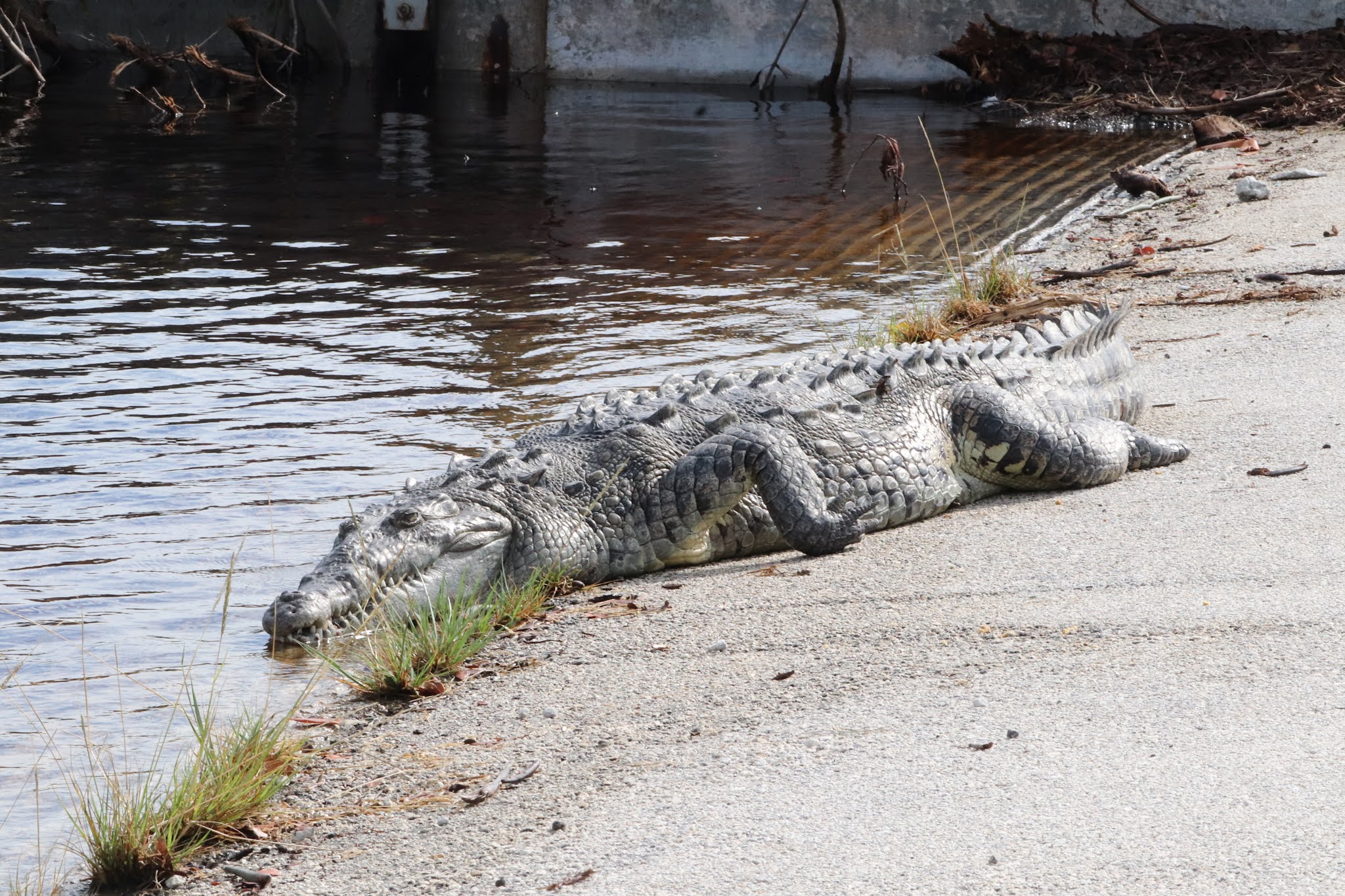
   The following day on our way back to Flamingo from a trip up to the Anhinga Trail we stopped again. One of the Crocodiles was sunning itself near the freshwater boat ramp. As you can imagine, I watched it for over half an hour taking a ton of photos and admiring it. 

American Crocodile sunning at the boat ramp


   After we packed our tent we drove up to Long Key Campground to set up for the night. We stopped at a roadside lake called Nine Mile Pond. Not twenty feet from the parking space was a HUGE crocodile about fifteen feet long. The park rangers named her Croczilla. She was an absolute giant. Easily twice as long and wide as the one at the boat ramp. To be considered "safe" from a gator or croc the park says you need to be at least fifteen feet away. Fifteen feet is nothing and I was surprised you are allowed so close. Being that close with my 600 mm lens meant I could do some damage. With my lens completely zoomed I get get full photos of just the teeth.

Croczilla was huge. I had to stand fifty feet back to get 
the entire croc in the photo


  Before setting up our camp at Long Key Campground, Laurie an d I ate lunch at a picnic area. After lunch we walked the trail across the street. The trail was narrow and it was impossible not to brush up against vegetation. This meant that I could not see where I was putting my foot as I stepped. Not an ideal situation in snake country. Hell yes I jumped back when I almost stepped on two snakes as they slithered  off the trail. I got a quick look at them and they were gray. Best guess they were Florida Red-Bellied Snakes.  

   After setting up our tent and sitting in the dark I saw a Cottonmouth

Manatees at Flamingo Marina

in our campground. If you read my post on Cottonmouths, you already read it, so I won't write the story again here. 

  All in all, I loved our trip to the Everglades. The thirty eight mile road is awesome and, at least in November, very lightly travelled. All the people seem to be on the Anhinga Trail and in Flamingo. We saw almost no one at the hammocks and ponds we stopped at. The wildlife was amazing. There are a bunch of pictures below. If you have any questions about the glades or the wildlife please ask. I tried to fill this post with as much useful info as I could but I will be happy to answer any specific questions in the comments.


Barred Owl sleeping right next to the trail

I walked within five feet of this well hidden six foot gator before I saw it

Vesper Sparrow


This huge alligator was seen roadside on the way to Flamingo.
Too bad it was facing the wrong way

Red Shouldered Hawk greeting us at the entrance to Flamingo Campground

Anhinga drying off at the Anhinga Trail

Yellow Billed Cuckoo @ the Anhinga Trail.

Since I was looking into the water for manatees, tarpon, and crocodiles, I walked within ten feet of this osprey sitting on a post before seeing it. It didn't mind. I took five photos and kept walking. It was still there until a Red Tailed Hawk scarred it off.

Thursday, November 25, 2021

Things I am thankful for

We interrupt our regularly scheduled posts about Florida to bring you a post about things I am thankful for.  Regularly scheduled posts about Florida will resume tomorrow.


   Every year I do a post where I write what I am thankful for in the outdoors. I do a list of between ten and twenty things I am thankful for. Some of the things are on the list every year such as New Hampshire, Stripers, Dave and Laurie.  However, this year because of rescheduling things that were planned from last year and because I needed breaks from my stressful job, I did a lot of fun things. To list them off as things I am "thankful for" would just be self serving. So I am not going to do that, besides, I do an end of the year review anyway, so I'll write them there. 

  During the last two weeks I have dealt with death and life. Because of this, my post about being thankful has a different perspective from other years. Since I was vaccinated in May, I have been living as though the pandemic is over. I trust the science. I trust that if I were to catch Covid, the vaccination will keep me out of the hospital. I do not fear being out in the public, working, and obviously I don't fear travel. This feeling is not being cocky or arrogant. Like I said, I trust the science.

   However, Covid is very much real. Over the last two weeks, I lost my cousin, Mark. I was closer to him than any other relative. After a long fight he passed away last week. He lived in Maine and I visited him there a couple of times. We took a week long vacation to Florida a few years back. I will miss him.

   On rhis trip to  Florida I almost drowned. It's a long story, but I went snorkeling without my fins on and I almost didn't make it back to the beach. I can not exaggerate enough that I thought I was going to die. I have not been as scared as I was in my life. I really thought it was the end. 

   So as you can imagine, losing a close cousin and almost losing my life has gotten me thinking. As my second cousin's and Mark's brother have their first Thanksgiving only days after he passed, I write this thankful to be alive and sad I will never see him again. 

   Since I almost drowned I have had almost nightly vivid dreams that I was about to die (different ways, not just drowning). These are just dreams and when I wake from them I am back asleep in ten minutes. But I am very thankful to be alive. But it is more than that, I am thankful to be living. What is the point of life if you don't enjoy it? I enjoy it. My bad day happened on my fourth day in Florida. I still had eight more glorious days to enjoy. And I did. We did and saw a lot of cool things. I went snorkeling again just to make sure I wouldn't develop an uncontrollable fear of it. I spent about an hour snorkeling a couple of days later. 

   So this year, instead of being thankful for stripers, New Hampshire, or a quick trip to Philly, I am thankful for being thankful. I am very glad that sunsets don't seem prettier or that the mountain views don't seem more special. Because to me I have appreciated them always. I love my friends and I love the memories I have made this year. I planned as many trips as I could into this year and even when they didn't go as planned I still appreciated getting away. As I was reminded over the last two weeks, life is short. I'm glad I am still here to enjoy it. Though I will miss Mark, I have great memories from the trip to Florida.  For all the reasons above,  I am thankful.


"I'm not here for a long time, I'm here for a good time"

-various artists and Mark Vieira


Monday, November 22, 2021

Florida Suburban Wildlife

White Ibis

   I have spent twenty four days in  Florida between my trip in 2019 and the one that just ended. I dedicated a few of those days to birding, but even when I wasn't birding...I was birding. I went to couple famous places like Ding Darling and Corkscrew. However, you would probably be shocked to know that I got the highest percentage of my Florida lifers at a Walmart parking lot.

Yes, you read that right. I've seen Painted Buntings at Corkscrew, Reddish Egret at Ding, and Magnificent Frigatebird on the Keys, but I have gotten more lifers and Florida state birds in Walmart parking lots.

Eurasian Collared Dove

   On my first trip to Florida we went to the Walmart in Florida City, which is the last town before going to the Keys. We stop there to get supplies and food that we didn't bring on the plane. In the parking lot  I saw my lifer Eurasian Collared Dove, and birds I'd only ever seen one other time Boat-Tailed Grackle and White Ibis. This trip I got a lifer in the parking lot when we saw a flock of Muscovy Ducks. 


Muscovy Ducks


   In a Walgreens parking lot I saw a bird I know I had never seen, it turned out they are Common Myna birds. Lifer and an unexpected surprise. 
Common Myna


   A lot of the wildlife in Florida has adapted to people. Of course, there is urban sprawl and a lot of wildlife is displaced. But some species like the White Ibis and Boat-Tailed Grackle like to be around people for free food.  

   The whole Mallory Square area of Key West is concrete. Yet, you can find some amazing wildlife. This trip I found White Crowned Pigeons which were a lifer. From what I saw, they seem more wild than regular Feral Pigeons.  They were eating berries off of Palm Trees and not looking for scraps. 

White Crowned Pigeons


   Of course, Key West is famous for the wild chickens (Jungle Fowl) running all over town. We saw them everywhere. They are wild birds and actually countable on the ABA list. They seem to be expanding their range. We saw them at a Winn Dixie on Big Pine Key and as we were driving off the Keys, I think I saw them on Key Largo. 

Wild Chickens (Jungle Fowl)


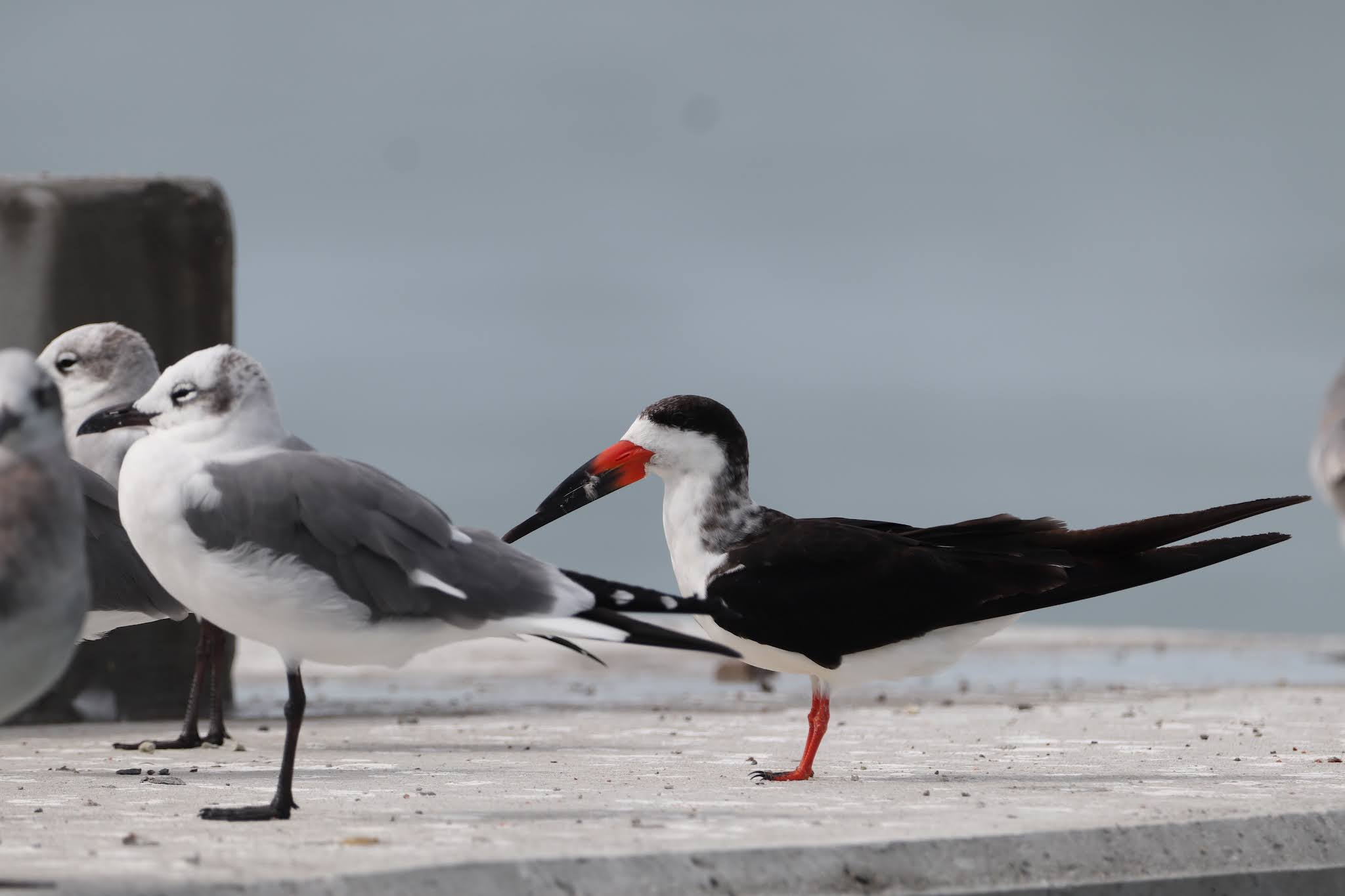
Just off the bulkhead at Mallory Square are a couple of concrete structures. They are only fifteen feet from the mainland. Yet, that is enough room for birds to feel safe. I've seen Black Skimmers on these structures every time I've been there. Because of the water between us, they are much closer than they would be on a beach. So, easy photos! Also, Laughing Gulls and Brown Pelicans will land on these posts. 

I will never turn down the
opportunity to look at Black Skimmers


 Lastly, while driving to Six Mile Slough we passed a college campus. Feeding right next to the road were three gorgeous Sandhill Cranes. We pulled into the campus entrance and I walked back over to them with the sun at my back. They didn't seem to mind me being forty feet away since they kept feeding. It was a challenge to be patient for them to lift their heads up as traffic was flying by me. (I was safely off the road, but must have looked like an idiot).


  The point of this post is to remind you if you go to Florida looking for wildlife, don't stop looking. Much of the wildlife has become used to having people around. This makes for easy photos and fun viewing. If I did a post that included wildlife I have seen in campsites I have stayed at (not even the campground as a whole, just my site) my list would include racoons, green herons, iguanas, night herons, warblers, and now fish.


Boat Tailed Grackle at Walmart

Palm Warblers were everywhere. Waiting for one to stop moving for a 
photo was the hard part.

Saturday, November 20, 2021

Bahia Honda, a Key's Gem


 We stayed at Bahia Honda State Park (pronounced Bay) four nights of our trip. We had only planned to stay for the first two nights but we loved it so much we changed our whole vacation around to go back for the end of our trip. Bahia Honda is about sixty miles down Route 1 in the Keys, or coming from Key West, thirty eight miles north. 

  The park has shoreline on the Atlantic Ocean to the south and the protected Florida Bay on its northern shore. There are two campgrounds separated by the low clearance of the Route 1 bridge above. The campground we stayed at is called Bayside Campground. It only has a few tent sites. The cost to rent a site is $40 plus a seven dollar reservation fee. Fifty dollars is a lot for a campsite, especially a state owned tent site, but still, cheap lodging for the Keys. 

   We spent time in three different sites. All of them are on the water. The sites are so close to the water that one of them floods on a moon tide. The view from the campground and other parts of the park are awesome. 

Yellow flags mean to use caution while 
in the water. Overseas Highway in the 
background

   You can snorkel/swim in both the Atlantic and the Bay. There are buoy's a couple hundred feet out that keep boats from running over snorkelers on the ocean side. On the bayside, there are ropes you have to stay inside. The snorkeling is far better on the ocean side. There is a distinct line where the tan sand meets the green eelgrass. The water is only about 4-7 feet and in many places you can touch bottom.  Once you snorkel out to the eelgrass, you never know what you will see. I snorkeled in the eelgrass for an hour one day. I found a huge live Conch, Schoolmaster Snapper, a Pipefish (which is basically an elongated seahorse with Seahorse face), and a bunch of other colorful small fish. 

   I wanted to snorkel the ocean again the following day but it was too rough. So I snorkeled the bayside. The eelgrass did not have as much life. However the jetty had a lot of fish around the rocks including a big school of Yellowtail Snapper. 


Barracuda twenty feet from our tent!

     If you want to see fish but are afraid to snorkel, not to worry. The water right along our campsite was loaded with small to medium size fish. There were two small Barracuda living there. Also around were Sargent Majors, Parrotfish, and Porkfish. There were other fish that we could not identify. These fish were in ten inches of water and easy to see from the shoreline. 

   Whether you are a camper or their for a daytrip, there is plenty to do. as I said, you can swim and snorkel on both sides of the park. Fishing is also allowed. I saw multiple people fish especially during the night. There is a marina where you can rent snorkel equipment. You can also take a boat ride out to Looe Key, the premier snorkeling spot on the coral reef (the weather never lined up with me to do that). You can also buy food at the marina along with clothes and gift shop stuff. 

Bahia Honda is close to other cool spots. The Key Deer National Wildlife Refuge is a few minutes to the south. To the north past the Seven Mile Bridge is the town of Marathon. all of the touristy things are there from restaurants to expensive golf courses. There are places to rent an do all sorts of water acrivities like rent a boat, deep sea fishing, jet skis, and many more. 

  Lastly, Key West is only an hour away. You can easily do a daytrip or more to KW without any trouble. 


   I should also point out  I did a little birding at BH. I got a photo upgrade of a Kestrel that seems to live there. I saw my first ever Magnificent Frigatebird that flew over from the bay to the ocean. I saw and got photo upgrades of Yellow Throated Warbler which is very rare to see in Rhode Island. I also looked for a couple of hours for White Winged Doves which were spotted in between the beginning of the trip and the end, but I couldn't find them. 

   All in all, Bahia Honda is one of the best places I have ever been. There is a lot to do  if you like water or fish. The campground is awesome (though, if the wind wasn't blowing, we did get bit by no-seeums). The rangers were really nice. Basically, it is paradise.

Cottonmouth, Pics or it didn't happen


   I went to South Florida for the better part of two weeks with my friend Laurie. We did a lot of different things. I'm sure I'll have a dozen posts about the trip. Hopefully with info on what to do and how to improve on our trip. I'm starting my posts off with the one thing that got my heart racing-

 On our trip I saw a Water Moccasin on three consecutive days. I got photos of two of them. Before I go any further, Water Moccasins also go by another name, Cottonmouth. Both words are for the same species. It seems like many Northerners call them Water Moccasins, and down South it is a 50/50 split. Whichever term you use, it is the same species. I have been surprised to learn that many people I know don't know that. I prefer the term Cottonmouth, so that is what I'll be using from now on.

   The first snake I saw was the smallest but by far the scariest. Laurie and I were sitting around the tent after dark when I heard our next site over neighbor say "it's on the trail to the showers?". We walked within my view and I asked him if he was going to look at cool wildlife. He replied there was a Cottonmouth near the showers and he was going to move it. I asked if I could go with him. I followed him up to where the snake was. Sure enough, it was right out in the open fifteen feet from the shower entrance. We bent down to look at it and we could see it was finishing up eating a little Ribbon Snake.

    The Cottonmouth was only 15-18 inches.  My neighbor moved it off of the trail and into the brush so no one or the snake would get hurt. Also of note, he had talked to a park ranger and earlier that day a six foot Eastern Diamondback slithered through the campground. Needless to say, when I woke up to use the bathroom in the middle of the night I did not venture far from the tent. 

Snake 2

   The next day after being disappointed at Corkscrew by lack of, really any wildlife, we decided to go to Six Mile Slough. While we were there, a woman told us about a Cottonmouth down the boardwalk. She gave no directions at all but we went looking for it. While striking out looking for it, Laurie asked a worker if he had seen any snakes. He had seen the Cottonmouth and told us exactly where to go. I bolted to find it leaving poor Laurie in the dust. My heart started racing and my adrenaline was pumping. I was so excited. The snake was still exactly where the guy said it would be. It was ten feet off of the boardwalk sleeping all curled up. We watched it for twenty minutes.

Snake 3

The following day we took a very long ride to Stormwater Treatment Area 5/6. This place was kind of a bust for us also. On the way back to our campsite Laurie decided to stop at some random park with trails (I don't remember the name of it). We walked the trails through some pines to a sawgrass swamp. We didn't see anything other than a Common Yellowthroat Warbler and a Little Blue Heron. As we were walking back the way we came, in the corner of my eye I saw a snake crossing the path where two trails meet. Instantly we could see it was another Cottonmouth. The path was wide through the pines and I had plenty of room to view it. 


 I got down low and started firing shots with my camera. As it was approaching the other side of the trail I stood up and took two steps towards it, The snake stopped instantly. I kept taking photos of it. I got behind it and took photos from across the path from which it came. I took a step or two closer and the snake turned its head toward me and opened its mouth to show me its  cotton mouth. 

  This was a warning that I better back off. I did step back a couple feet and took some more photos. I love the fact the snake was basically saying "I don't want to fight you but if you come closer I won't back down". After it showed me it's mouth I went back to the other side of the T- intersection. We watched it for another minute or two admiring it's beauty, power, and temperament. We left it alone and it was still on the edge of the woods when we left. What an amazing experience. 

   
I posted these exciting parts of our vacation on Facebook. My son's mom, Crystal, responded with "Pics or it didn't happen". Hence the name of this post. More photos below


Saturday, October 30, 2021

Kokanee- One of the top things on my Bucket List


  Some bucket list items can be done just by doing it. For instance, getting a slice of pie in Key West or a drink in a bar that Hemingway went to. Some bucket list items are just seeing something, like Lady Liberty, Independence Hall, or Mt. Rushmore.

    Then there are those that are a challenge. Not only do they require the travel to get to, but there are no guarantees when you get there. These things have the highest risk but when they are accomplished, also the greatest reward. Yesterday, I went fishing for Kokanee in Connecticut, a fish I have wanted to catch for years. 

   Kokanee are a landlocked version of Sockeye Salmon. Sockeye are Red Salmon. The state of Connecticut stocks fingerling salmon in a few lakes in the state. The salmon are caught as adults in nets set out by Fish and Wildlife. The state strips the females of eggs and fertilizes them from the male's milt. They wait for the eggs to hatch then put them back in the lakes as fry and fingerlings. After a few years growing in the lake they try to spawn at the outlets and inlets. Of course, they are unsuccessful but they try none the less. They are wild fish in all ways except for their place of birth. Since they are landlocked and only have a short lifespan they don't get very big. The males reach about fifteen inches and based on the hundreds I saw yesterday, the females an inch less.

  Red Salmon are plankton eaters and while spawning they do not eat. As with all Pacific salmon they die after spawn. When they strike a lure it is out of aggression. They are not trying to eat it. They get annoyed and strike out of anger.

Three years ago I went to catch Kokanee but it was an epic fail. I drove two and a half hours the first week of November to a Kokanee pond. I knew before I stepped out of my car that I wasted my time. The lake was drawn down about six feet. The spawn was over.  I did drive over to the Farmington River and catch a Brown Trout, but overall it was a bad experience.  I wanted to go back the next two years, but birds got in the way.

   Yesterday I went to the same lake to try again for Kokanee. I got there about 9:30 am. I purposely went the last week of October instead of November to avoid the drawdown. Still, I knew very little about Kokanee and just hoped the spawn wasn't over.

  Luckily, when I got out my CRV the water level was high. Also, I saw some dead rotting salmon in the water. I took this as a sign that fish were around as opposed to them all being dead. I put on my waders and made some casts. I know enough about Kokanee to know they are hard to catch. I didn't expect to catch a whole lot. I would have been thrilled to catch one. After making a bunch of casts without any luck, I walked to the other side of the cove to where there is an outlet. I looked in the water and a hundred fish were stacked up right next to the outflow. All of them were bright red in beautiful spawning colors. I had seen a video where a fisherman caught Kokanee from this lake using a countdown Rapala. That's what I had on the line. Swimming it through these fish fifty times produced one snagged Kokanee but no hits. 

  A note about snagging. I knew before I left how hard it is to get Kokanee to bite. I also know that when they are stacked up, there is a good chance of snagging them. I also know that people purposely snag salmon because it is much easier than trying to fool them into biting. On my way down, I made a decision that if I snagged one  I wasn't going to count it as a "caught fish". I wouldn't get any joy out of snagging one. This was a moral decision that I was going to stick to even if I was alone. I really wanted to fool one and catch it the right way. So when I snagged the first Kokanee, it annoyed me more than excited me.

   After fifty casts into a hundred fish, I switched to my fly rod. I put on a bright pink Wooly Bugger hoping the gaudy color would fire them up. Still no luck. I wondered if any of these fish would be "aggressive" enough to take a lure.  About an hour after I started fishing the outlet, another fisherman showed up. He fished near me and caught two Kokanee in the mouth. He was using a tiny Kastmaster and it seemed to be working. He offered me one and I accepted. However my luck didn't change. He caught another while I stayed skunked. 


   It turned out that this fisherman was New England fishing legend Roy Levya. This guy has caught everything under the sun and trophy fish of many varieties. I thought it was Roy while we were fishing. When we finally introduced ourselves it was confirmed. We talked a lot and I asked some questions about the Salmon River in NY. 

   After another thirty minutes of blanking with the Kastmaster I tried a small Pheasant Tail fly on my fly rod. After about ten minutes a Kokanee came up and hit it. Luckily for me it didn't fall off the hook. I netted it with Roy's net. As you can imagine, I was really excited to have caught one and even more so to have gotten it on a fly. Roy was kind enough to take a bunch of photos for me. I took some more of the fish in the net and water. Roy was jealous I got one on the fly rod.

   I didn't catch any more on the fly rod. But I did catch two more on the small Kastmaster. One of them was a beautiful hook-jawed male. I did snag a few others. I tried to shake them off, but a couple I did have to reel in and pull the hook out and release. 

  Thirty minutes before I left two young guys came down fishing for trout. When they saw all the Kokanee they wanted to catch them of course. They had no chance of catching them on Powerbait. So I gave one of them a nymph to use. Before I left, I paid it forward and gave the Kastmaster that Roy gave me to them. Hopefully they got some fish.


  Catching a Kokanee has been something I have wanted to do since I was a little kid. After my first failed attempt three years ago, it has been on my mind. However, it was so much easier the last couple of years to go birding with my friends the last week of October instead of making the five hour round trip drive. Even when I got up yesterday I puttered around for an hour before committing to such a long drive. However, this year I was going to go no matter what. I am glad I did.