Friday, September 11, 2020

Some photos from a crappy weekend

    I didn't really enjoy my days off this week. I fished hard and birded hard but came up short everywhere. Thursday I got rained out birding and rained on fishing. I didn't catch any albies. Friday I looked for shorebirds that have been eluding me for weeks. Still haven't seen them. Then I went fishing and got skunked again.

   However, I did get a photo upgrade on Spotted Sandpiper. I also saw one of my favorite birds at Napatree, Red Knots. They aren't red this time of year because they are winter plumage. They let me get pretty close while they were feeding and I got some of my best shots ever of them.


The first five photos below are of Red Knots


Ruddy Turnstone

Ruddy Turnstone

Spotted Sandpiper
Photo upgrade

Black Bellied Plovers

Wednesday, September 9, 2020

Block Canyon Trip

 
Yesterday I went on what was supposed to be a dedicated birding pelagic. Every year, my friend Carlos goes out on an all day pelagic trip to canyons out in the Gulf Stream. They charter a tuna boat to take them to see birds that you can not see from shore. Last year when I was doing a RI Big Year, I told him if anyone backs out I'd like to be the "first alternate". No one backed out and I was fine saving the money.

   Because of myself and interest from others, Carlos booked two trips this year. One for August 25 and the other for September 8th, The people going on the August trip are the same six (the boat only holds 6 people, hence it is called a six pack) that go every year. Unfortunately for them, they got blown out thanks to big waves. This really sucks because you do not sign up, spend all that money, wake up at 1:30 am, unless you really, really want to go.

   The marine forecast called for 3-5 foot waves and we thought we wouldn't be able to go also. A last minute decision was made that if we couldn't go out to the Gulf Stream we would do a more manageable trip to Cox Ledge. So I got up before people were getting home from bars to be at Snug Harbor at 2:30 am. We headed out and for three plus hours we cruised at 30 knots. We made it to Block Canyon one hundred miles from shore!

   Before I go on, I need to say, my big 600 mm camera lens was still in the shop. I had to take my small lens that goes to 300 mm. I mentally prepared myself to be a birder not a photographer. This was hard because I may never see these species again. But, I told myself seeing them was the important thing. I got lucky with a couple of species that came close to the boat and got some good photos. Cory's Shearwater was a bird that is fairly common that I didn't have a photo of. Luckily for all of us, Tim Metcalf has a good camera and he took some awesome photos. Every time a good bird was too far from the boat, we all looked at Tim's photos for the ID. But I digress...


Cory's Shearwater
Life photo
 To all of our surprise the Captain put some rods out telling us the lures on the water would "lure in birds". About an hour into cruising around looking for birds, a rod bends over. None of my five birding friends fish, so I got to catch a tuna.  It ended up being a decent size Albacore going 50-60 pounds. I also caught another Albacore that went over thirty. I can tell you for sure, I never need to catch a tuna over 60 pounds. I was sweating, all of my muscles from my legs to my lower arms tightened up. Tuna are strong! I also caught a mahi-mahi that went about 35 inches.

   As for the birds, we also had a great day. We saw all three species of Jaegers before noon. Pomarine Jaeger was a lifer for me. We got good looks at Manx, Great, and Cory's Shearwater. Cory's was a life photo. On our way in we saw a South Polar Skua which was the best bird of the day. It was my second lifer. We had dozens of Red-Necked Pharalopes on the water as we reached Block Island Sound.

 
Pilot Whales
Besides the birds we saw multiple marine mammals.On our way out we saw Bottled Nosed Dolphins and Pilot Whales. A Humpbacked Whale breached while we were birding but I was on the wrong side of the boat. Lastly, on the ride home we saw a huge pod of Atlantic White Sided Dolphins.

 
   When we got in, the Captain and mate steaked the tuna. We all went home with a couple Ziplock bags full of tuna. I have enough to make six meals after giving some away. I/we each could have taken more since there was over a hundred pounds onboard (live weight). We left enough for the Captain and mate to have a couple of meals.

   I can not stress enough how great of a day this was.  Each of us saw six species we had not seen yet this year. I got two lifers  (Pomarine Jaeger and South Polar Skua). We saw four species of marine mammals (Pilot Whale was a lifer). Plus I caught two new species, one of them (mahi-mahi) was on my bucket list. The other, the Albacore, is the largest fish I've ever caught. Not to mention we all went home with fish. So basically I got to go on
a tuna charter and a birding charter for the price of one.
South Polar Skua

Other species seen that were not year birds or lifers- Great Shearwater, Common Tern, Lesser Black-Backed Gull, Wilson's Storm Petrels (everywhere)

Multiple photos below


Tim Metcalf got this photo of  a Manx Shearwater


Pomarine Jaeger

The top bird in the photo is a Parasitic Jaeger.
Its not much, but it is a life photo

These two photos (above and below) are of a Long-Tailed Jaeger.
Clearly the best bird photos I got today.


Tuna Steaks

Thursday, September 3, 2020

Tinkering with my settings for sunset

  Tonight I went for a walk at Stony Brook Audubon Sanctuary in Norfork, MA. I just didn't want to waste my night and it is close to home. My big lens is still in the shop and I wanted to practice taking photos anyway. I stayed through most of sunset. I didn't stay until total darkness which was my plan. It turns out the mosquitoes were hungry and I was on the menu. So I got back to my car with quite a bit of light left.

   I took a bunch of photos of the sunset all from the same spot. The view was over the pond. I put a Purple Loostrife in the foreground. Purple Loostrife is the pretty yet very invasive purple flower you see in marshes. I tried a bunch of different things with my camera. I played with shutter speed and flash mostly. Many of the photos did not come out well, while others did. I am including some of the bad photos below.

  None of these photos have been enhanced in anyway when I got home. I didn't play with light, color, or saturation. It is amazing what a camera can do. I will not bore you with the file info on each of the photos. If I were sitting on your side of the computer, that would bore me to tears also. Besides, it is fun to experiment on your own. As you scroll past, keep in mind these photos were all taken in a five minute period. There was still plenty of light left as you can tell by the last two photos. Some are clearly darker than others, but it isn't because it was getting darker outside.

   Lastly, I have a pretty nice camera, but the truth is most cameras have the same settings I played with tonight. Hell, most cell phones allow you to adjust your photos and settings. My hundred dollar point and shoot that I keep in my pocket on vacations can do what I did tonight.

   Don't worry, not every post is going to be about camera settings and different things I am learning, but for some of you, it must be nice to see something on this blog other than bird photos, right?


Wednesday, September 2, 2020

Playing with my F-Stop and Shutter Speed

   Before you look at any of the pictures below or read any text, I want you to know I do not believe any of these photos are award winning. I took them as practice while trying to learn what my camera is capable of. 

I am embarrassed to say that for most of my life I haven't know what many of my camera settings were. I didn't understand Aperture or ISO. Of course, I knew what Shutter Speed is, but not what to do with it. For the last couple of weeks I have been watching online classes about photography and travel photography. I don't know if I am a better of a photographer, but I sure am a more knowledgeable one.

This week, I practiced a little bit. The weather was nice, and I didn't have any excuses to stay inside. I went to Trustom on Monday. There I played with the Aperture Priority on my camera. In case you are like me, and don't understand what Aperture is I'll explain. 

Aperture is the amount of a photo that is in focus. Aperture is measured in F-stops. The lower the number (like F2.8 or F4) the less of the photo will be in focus. Conversely, the higher the number (like F16 or F22) the more the photo will be in focus. You are probably asking "shouldn't you want the entire photo in focus all the time?". The answer is no. Truthfully, more often than not, the opposite is true. I'll give some examples. Obviously, I take a lot of photos of birds. Lets say I get a nice close up of a bird in a tree. I want that bird to stand out. So if the bird is focused but the background blurred it will stand out more. If every leaf is in focus and every branch the background could look too "busy". The same is true of portraits of people, if you take someones photo at a park, they will look much better (sometimes) with a blurred background than they would with focused trees, powerlines, etc behind them.

On the other hand, there are times you want everything in focus. If your taking a photo looking down busy tourist street you might want to read every sign on every building. If I come across a heard of elk in the distance, I want the entire herd in a field focused.

Now, as I said, I just learned this, but luckily auto-focus on my camera knows these things. Auto-focus can adjust and correct on the fly. You can take beautiful photos and never turn the dial off of auto. However, we have all looked at photos and didn't like it for some reason. I know I have. Sometimes I wish a bird was more in focus. Or I took a photo of a place and it looked too cluttered. If I would have changed my settings, maybe with practice I could have gotten the shot I wanted. 

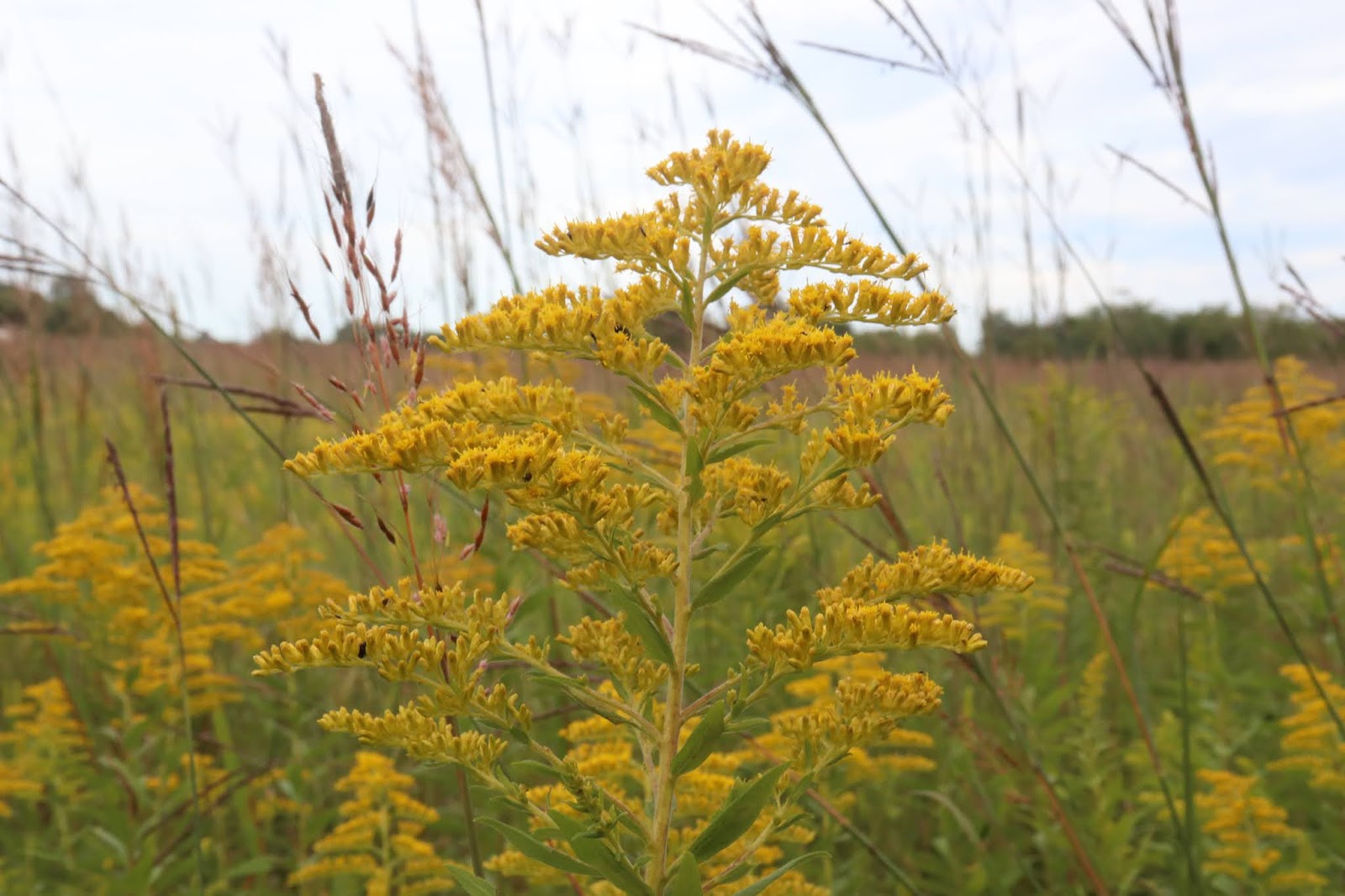
Below are some photos of Goldenrod and Milkweed I took at Trustom with different F-stop settings. You can see how the background is more or less in focus. I was using my small lens so I could get close. In the photos, the Goldenrod and milkweed may seem to be different distances in different photos. But the truth is, I was right next to both. The distance couldn't have been more than a couple inches as I might have straightened my neck. That isn't the point anyway, the difference in the background is. 

Below the Goldenrod and Milkweed are photos and an explanation playing with Shutter speed.


F5.6
Notice how blurry the background is.

F7

F25

F4

F5.6

F20
Those trees are 60 yards away and you can almost see
the detail of each leaf.

F4

F8

F20
Shutter Speed is how long your shutter is open when you take a photo. For a moving object like a person running, you want a very fast Shutter Speed or else the person (or in my case all the time, flying bird) is blurry. You need a lot of light for a high shutter speed because the hole that lets in the light is only open for a tiny amount of a second. On the other end, if you are photographing near dark, you need a slower shutter speed so the hole is open longer and lets in more light.  The one problem with a slower shutter speed is camera shake. No matter how steady you think your hands are you are not perfect. A camera shake will make a photo come out blurry. 

  Last night I went for a bike ride in Lincoln. I stopped at one of the dams that creates a waterfall. My goal was to create the flowing effect you see in photos of moving water. The light was okay on the whole fall. However, I noticed a Great Blue Heron in the middle of the spillway. It was pretty far away so I had to zoom in, I lost most of my good light. I really didn't care. I was just practicing. I started with a slow shutter speed and moved up. I only played around for a few minutes because I got a phone call and had another five mile ride back to my car. Still, I learned a couple things. See below


This photo was taken with a 1/4 second shutter speed. I took three at this speed and this was the clearist. What did I learn? One quarter of a second is too long to hand hold a camera without shake

The photo below is at 1/8 of a second. It's pretty clear. The water has the flowing motion I was hoping for


Below 1/15 of a second


1/60 of a second. The water has a little more detail


This photo was taken at 1/1000 of a second (yes three zeros) Notice how you cans see individual droplets. The water was basically frozen in time


Lastly, this one below is at 1/2000 of a second. The water is the same. I doubt anyone can distinguish bits of time that small. But the camera did. Notice how it is darker than the photo above. It did not let in as much light and it shows.  The light was the same. Both photos were taken 5 seconds apart and there wasn't a cloud in the sky.
Like I said above, none of these photos are getting me an interview with National Geographic. However, I did put some of what I learned in play. It was fun. I still need to practice, practice, practice. I don't want to have my camera on the wrong setting when a Connecticut Warbler lands on a tree limb five feet from me.

Monday, August 31, 2020

   
One thing I hoped to do this year was to get some pics of fawns while they still have spots. Quite frankly, I failed miserably at trying to achieve this goal. Instead I spent most of my days chasing animals with feathers and the occasional evening looking for beaver. So tonight it was pure luck that I not only ran into a doe and a fawn, but two does each with a fawn. Though the babies are easily 70-80 pounds by now, they still have spots. Thanks Mother Nature for throwing me this bone